


The second quarter offered another reminder that markets are forward-looking machines, not current event scorekeepers. Geopolitical tensions were ever-present, and provocative apocalyptic tweets from the administration threatening “obliteration” triggered daily gyrations. Yet the sharp recovery in April and continued momentum in May meant investors were able to look through the unnerving headlines and focus instead on the more benign picture of resilient U.S. and global economies, the solid labor picture, healthy consumer spending, historic corporate earnings growth, and the long-term implications of AI’s stimulative capital expenditures and technological breakthroughs.
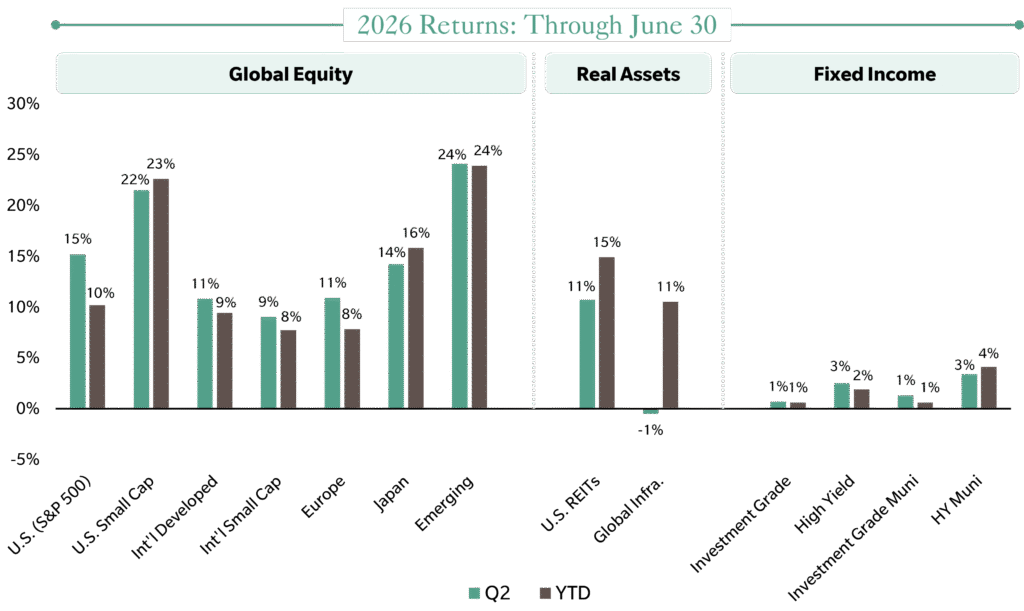
Risks remain, of course. The situation in the Middle East is by no means settled. Inflation is still running uncomfortably high. The enormous capital expenditure on AI may prove to be based on exuberant expectations. And valuations of stocks in the U.S. are in vulnerable territory. With the truce (fragile as it is) and oil flowing again, however, the second quarter notched a decidedly healthy return across the asset class spectrum. In fact, U.S. stocks posted the best quarter in over six years.
A strong rebound from the sell-off in March
Source: Standard & Poor’s, MSCI, FTSE, DJ Brookfield, Bloomberg, ICE BofA. Index returns. Any investment can result in total loss. Past performance is not necessarily indicative of future performance.
Looking Through the Oil Turmoil
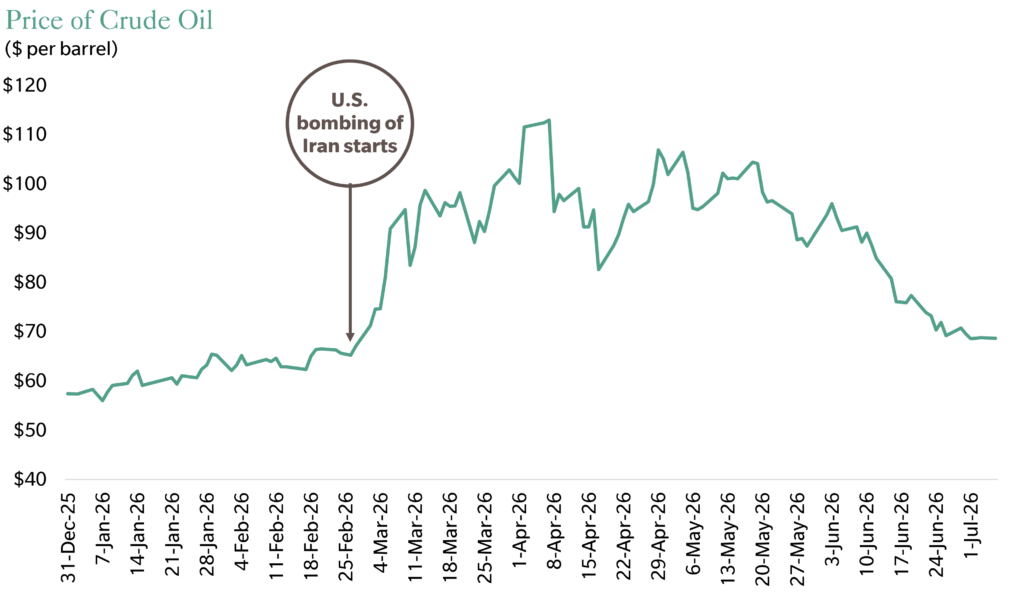
Perhaps the most striking characteristic of the quarter was how quickly markets digested significant geopolitical shocks. The US bombing of Iran on February 28 set in motion a predictable reaction in March and early April: Equity markets recoiled – international and emerging market equities both suffered double-digit declines. Crude oil prices rose by almost $50 per barrel in less than ten days. Treasury securities and other safe-haven assets rallied. Uncertainty indicators such as the VIX and MOVE indices — measures of stock and bond market volatility — spiked. Investors contemplated the possibility of a broader regional conflict. Predictions of prolonged market weakness and recessions ensued, understandably so, as oil, natural gas, and their derivative products (gasoline, jet fuel, industrial chemicals, fertilizer, plastics, etc.) are so integral to the functioning of our global economy.
Oil Turmoil: Prices spiked, hovered around $100, then finally retreated
Source: U.S. Energy Administration
Yet thirty days after the first bombing, equity markets bottomed and then began their dramatic recovery. Markets “looked through” the oil turmoil and believed that the global economy was not going to be derailed. What helped, as well, was a combination of supply and demand flexibility and ingenuity that helped blunt the massive decline in available oil coming through the Strait of Hormuz. All spare capacity was turned on by Saudi Arabia and the UAE. Alternative pipelines were utilized that bypassed the Strait. The U.S., China, Japan, Europe, and the world over tapped their Strategic Petroleum Reserves. On the demand side, we saw airlines around the world reducing marginal flights, trucking and freight companies using better route optimization and cutting back on partially loaded trucks. And yes, even American families started carpooling. Efforts large and small helped close the gap. The net effect: while gasoline prices did jump, they never even reached the prices that we saw back in 2022 when Russia invaded Ukraine, and gas prices topped $5.00 nationally.
As the probability of a wider regional war diminished, markets rapidly shifted their attention back to economic fundamentals. Corporate earnings remained healthy, with the S&P 500 posting its best profit margins ever.
Profit margins at all-time high and expected to rise further

Source: FactSet. FactSet has been maintaining the Net Profit Margin since 2009. Today’s margins are the highest since they started measuring it.
Consumer spending continued to demonstrate resilience. Business investment remained robust, particularly in technology and infrastructure.
The lesson is not that geopolitical shocks are irrelevant. Rather, it is that successful long-term investing requires distinguishing between headlines and lasting economic consequences. During the second quarter, investors largely concluded that the latter remained intact.
Artificial Intelligence: A Rotation
Artificial intelligence remained the dominant secular investment theme throughout the quarter, but the AI narrative itself continued to evolve and broaden.
In 2024 and 2025, investor enthusiasm centered nearly exclusively around the mega AI hyperscalers: the massive cloud computing companies. Think Amazon Web Services, Microsoft Azure, Google Cloud Platform, and Meta (Facebook), all part of the Magnificent 7.1 The Mag-7, in fact, generated returns over 100% during that time frame, double the return of the S&P 500. 2026, however, has witnessed an impressive rotation. Mag-7 has actually lost money this year, down -3% and down -17% since last Halloween. Microsoft, alone, has suffered a 28% drawdown.
The baton has been handed to other AI beneficiaries. Think about the S&P 500 excluding the Magnificent 7 (sometimes called the S&P 493). Think small cap. Think upstream suppliers and downstream users of AI.
Rotation

Source: BlackRock, Roundhill Investments, and Defiance. The Mag-7 Return is represented by MAGS, the Roundhill Magnificent Seven ETF, and the S&P 500 ex Mag-7 is represented by XMAG, the Defiance Large Cap ex-Mag 7 ETF. U.S. small cap is represented by the returns of IWM, the Russell 2000 ETF. Past performance is not necessarily indicative of future performance. *YTD return is through June 30.
For upstream, old-line computer chip manufacturers have delivered jaw-dropping returns, as demand for their products has gone hyperbolic. The ETF that holds a collection of semiconductor companies, SOXX, is up over 110% on the year. Some notable individual companies include Micron Technologies (+288%), Taiwan Semiconductors +130%), and Korea’s SK Hynix Technologies (+250%). Wall Street traditionally valued these companies as mature businesses with earnings tied to painful semiconductor cycles of boom and bust, not as long-duration growth companies. AI has changed that perception materially.
AI requires enormous physical infrastructure: data center construction (land, labor, and materials), electrical generation and transmission capacity expansion, networking equipment deployment, and software redesign. Vertiv Holdings, an industrial firm that specializes in data center cooling systems, has seen its stock more than triple since last May. Other industrial companies, engineering firms, utilities, and communications infrastructure providers all stand to participate in this investment cycle.
Downstream users of AI are also being rewarded. Seemingly traditional Travelers Insurance company, for example, which has been processing insurance claims since 1864, has been aggressively incorporating AI bots and agents (not insurance agents, ha ha) to help streamline their processes. Call center overhauls, faster claims and processing, better fraud detection, more accurate underwriting, computer vision for damage assessments, etc. And they are just getting started. The fourth quarter of 2026 saw a 20% jump in earnings, which is close to triple the rate of typical mature, established business lines.
In other words, AI increasingly resembles previous transformational technologies that generated investment opportunities well beyond the companies responsible for the underlying innovation.
The Interest Rate Narrative Shifted: From Cuts to Caution
On a more sobering note, another development this quarter involved a meaningful change in expectations regarding monetary policy. It shifted from cuts to caution.
At the beginning of 2026, inflation numbers were on a comforting trajectory downwards, giving the Fed room for potential cuts. Markets anticipated a 50 bps (0.50%) reduction by year-end. This quarter saw a complete reversal in market mindset. Inflation improvement stalled out and even reversed course. Yes, some of that was driven by oil prices, but much of it was also driven by the very strength of the U.S. economy. The stimulative effects of OBBBA (One Big Beautiful Bill Act) were kicking in, as were relatively low borrowing costs for companies, as they saw the lowest credit spreads in nearly 30 years. Labor markets continued to demonstrate resilience. Enormous capital investment related to artificial intelligence and digital infrastructure raised legitimate concerns that the economy was, perhaps, too good.
As a result, investors increasingly questioned whether interest rates would decline as quickly, or as far, as previously anticipated. Even the new Federal Reserve Chairman Kevin Warsh, supposedly hand-picked by Trump for his dovish leanings, voted to keep rates high and even indicated a willingness to raise them.
This reversal matters because equity markets are influenced not only by the level of corporate earnings but also by the discount rate investors apply to those earnings. Higher interest rates generally reduce the present value of future cash flows, particularly for companies whose expected profits lie well into the future. And that matters particularly today because of where valuations reside, at the upper end of their historical norms. Today, investors are placing considerable confidence in continued earnings growth, successful AI deployment, and resilient economic conditions. Those outcomes are certainly possible. Indeed, many appear likely. But higher interest rates make any missteps in delivering those earnings more unforgivable.
This does not imply that markets are approaching a speculative bubble. Unlike past bubbles, the Technology Bubble of 2000, for instance, corporate earnings today have generally justified much of the market’s recent appreciation. Balance sheets remain healthy across much of corporate America. Profit margins continue to impress.
But interest rates moving from cuts to caution does inform our portfolio construction. And how we think about future returns and likely heightened volatility.
Looking Ahead
We began 2026 cautiously optimistic. Our thesis was that an uncommon and stimulative policy trifecta , including monetary, fiscal, and credit, set the stage for continued earnings growth and economic resilience. That thesis has been rewarded.
Today, as we look ahead, we must be a little more cautious and a bit less optimistic, as monetary policy may become a bit less accommodating. And valuations are at levels where the margin for error has diminished. Expectations are high. There is a lot of “good news” already baked into the pricing of securities. Today’s environment reinforces the idea of prudence. Diversify risk by holding more than just US large-cap stocks.
That means the following: a deliberate underweight to the most expensive segments of the market and a deliberate overweight to small and mid-cap names in the U.S. 2026 has seen a notable outperformance of these two sectors, and we believe there is further upside for patient investors.
It means a globally diversified portfolio, where non-US stocks are trading meaningfully cheaper than U.S. Emerging markets, in particular, have outperformed U.S large cap by over twenty percentage points this year.
It means exposure to real estate and infrastructure, where, by some metrics, they are the cheapest they’ve been in over 20 years. Signs that commercial office markets across the country are finally stabilizing are encouraging, with Class A office properties beginning to see firmer pricing as the return-to-office trend continues to gain momentum. Here, locally, Boston’s largest private employer, Fidelity Investments, just demanded that all employees come back to the office five days a week.
Finally, it means holding a below-average amount of high-yield bonds. While it is a good time to be a borrower, it is less of a good time to be a lender. The benign economic backdrop means we still own some high-yield, but we hold a less-than-normal amount out of prudence and risk/reward considerations.
While headlines will undoubtedly continue to generate periodic volatility, our investment decisions remain grounded in the same principles that have guided us through many market cycles: diversification, valuation awareness, fundamental research, and a long-term perspective. And of course, doing all this in a tax-sensitive manner.
The investment landscape continues to evolve rapidly, particularly as artificial intelligence reshapes industries and economies. There will be winners and losers in this transformation. Prudence and diversification has served investors well through previous periods of technological change, and we believe it remains the most appropriate framework for navigating the opportunities and uncertainties that lie ahead.
About Pete Chiappinelli, CFA, CAIA, Chief Investment Officer
Pete is a Partner and Chief Investment Officer at the firm. He is focused primarily on Asset Allocation in setting strategic direction for client portfolios.
This report is the confidential work product of Ballentine Partners. Unauthorized distribution of this material is strictly prohibited. Information obtained from third-party sources is believed to be reliable; however, the accuracy of the data is not guaranteed and may not have been independently verified. Some of the conclusions in this report are intended to be generalizations. The specific circumstances of an individual’s situation may require advice that is different from that reflected in this report. Furthermore, the advice reflected in this report is based on our opinion, and our opinion may change as new information becomes available. Nothing in this presentation should be construed as an offer to sell or a solicitation of an offer to buy any securities. You should read the prospectus or offering memo before making any investment. You are solely responsible for any decision to invest in a private offering. The investment recommendations contained in this document may not prove to be profitable, and the actual performance of any investment may not be as favorable as the expectations that are expressed in this document. There is no guarantee that the past performance of any investment will continue in the future.